
NestJS – Core Concepts to Learn
A Practical Guide to Building Scalable Backend Applications with NestJS
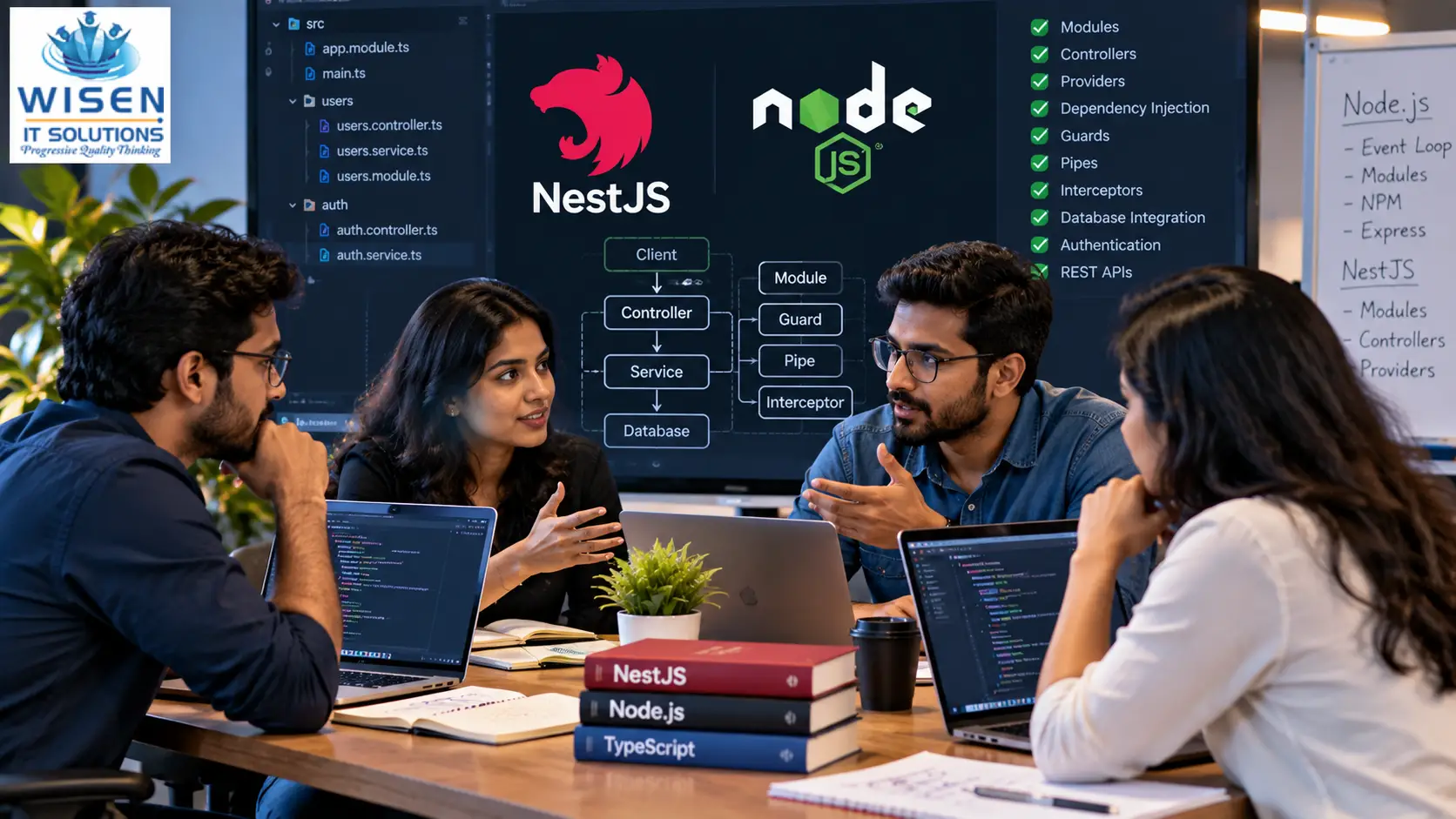
Introduction
NestJS is a progressive Node.js framework for building efficient, scalable, and maintainable server-side applications. It is built with TypeScript and provides a structured architecture based on modules, controllers, providers, dependency injection, decorators, and other powerful concepts.
Before learning NestJS, it is useful to have a solid understanding of Node.js fundamentals. NestJS builds on the Node.js ecosystem and adds a structured architecture for developing backend applications.
1. TypeScript Fundamentals
NestJS makes extensive use of TypeScript. Before working with NestJS, you should understand:
- Types
- Interfaces
- Classes
- Generics
- Enums
- Decorators
- Access modifiers
- Promises
- Async/await
- Modules and imports
2. NestJS Application Architecture
NestJS applications are organized around modules and their associated components.
Application
   │
   ├── Modules
   │     ├── Controllers
   │     ├── Providers / Services
   │     └── Other Components
   │
   ├── Middleware
   ├── Guards
   ├── Interceptors
   ├── Pipes
   └── Exception Filters
Understanding this architecture is one of the most important steps in learning NestJS.
3. Modules
Modules group related functionality into logical units.
@Module({
  controllers: [UsersController],
  providers: [UsersService],
})
export class UsersModule {}
Modules help organize large applications and establish clear boundaries between different business areas.
4. Controllers
Controllers handle incoming HTTP requests.
@Controller('users')
export class UsersController {

  @Get()
  getUsers() {
    return [];
  }
}
Controllers are responsible for receiving requests and returning responses. Business logic should generally be delegated to services.
5. Providers and Services
Providers contain reusable application logic. Services are the most common type of provider.
@Injectable()
export class UsersService {

  findAll() {
    return [];
  }
}
A controller can then inject the service:
constructor(
  private readonly usersService: UsersService,
) {}
6. Dependency Injection
Dependency Injection is a fundamental NestJS concept.
NestJS manages dependencies through its dependency injection container instead of requiring developers to manually instantiate every service.
constructor(
  private readonly usersService: UsersService,
) {}
Dependency Injection provides:
- Loose coupling
- Better testability
- Reusability
- Easier maintenance
7. Decorators
NestJS uses decorators extensively.
Common decorators include:
@Controller()
@Get()
@Post()
@Put()
@Delete()
@Injectable()
@Module()
@Param()
@Query()
@Body()
Understanding decorators makes NestJS code much easier to read.
8. DTOs
Data Transfer Objects define the structure of data entering or leaving an application.
export class CreateUserDto {
  name: string;
  email: string;
  password: string;
}
DTOs are commonly combined with validation decorators to validate incoming data.
9. Pipes
Pipes are used primarily for validation and transformation.
@Get(':id')
findOne(
  @Param('id', ParseIntPipe) id: number,
) {
  return this.usersService.findOne(id);
}
ValidationPipe is particularly important when building production APIs.
10. Middleware
Middleware executes during request processing before the request reaches the route handler.
Common uses include:
- Request logging
- Request preprocessing
- Authentication-related processing
- Request modification
11. Guards
Guards determine whether a request should be allowed to proceed.
They are commonly used for:
- Authentication
- Authorization
- Role-based access control
- Permission checking
Request
   │
   ▼
Guard
   │
   ├── Reject
   │
   └── Continue
12. Interceptors
Interceptors can execute logic before and after a route handler.
They are useful for:
- Logging
- Response transformation
- Performance measurement
- Caching
- Cross-cutting functionality
13. Exception Filters
Exception filters provide centralized error handling.
They allow applications to return consistent error responses across different API endpoints.
14. Database Integration
Most real-world NestJS applications need database integration.
Common technologies include:
- TypeORM
- Prisma
- Sequelize
- Mongoose
- Native database drivers
A typical architecture is:
Controller
    ↓
Service
    ↓
Repository / ORM
    ↓
Database
15. Authentication
Authentication identifies users within an application.
Important concepts include:
- Password hashing
- JWT
- Access tokens
- Refresh tokens
- Authentication guards
- Sessions
16. Authorization
Authorization determines what an authenticated user is allowed to do.
For example:
Admin
 ├── Create User
 ├── Delete User
 └── View Reports

Employee
 └── View Reports
17. REST API Development
You should understand how to build REST APIs using:
- GET
- POST
- PUT
- PATCH
- DELETE
You should also learn route parameters, query parameters, request bodies, HTTP status codes, pagination, filtering, and sorting.
18. Swagger / OpenAPI
Swagger/OpenAPI can be used to document NestJS APIs.
API documentation can include:
- Endpoints
- Parameters
- Request bodies
- Responses
- Authentication
- Schemas
19. Testing
Testing is an important part of NestJS development.
You should understand:
- Unit testing
- Integration testing
- End-to-end testing
20. Caching
Caching can improve application performance by reducing repeated database operations.
Redis is commonly used for distributed caching.
21. Queues and Background Jobs
Queues allow time-consuming operations to run asynchronously.
Typical use cases include:
- Email processing
- Report generation
- Image processing
- Notifications
- Data imports
22. Events
Event-driven architecture allows different parts of an application to communicate through events.
For example:
Order Created
      │
      ├── Update Inventory
      ├── Send Email
      ├── Create Invoice
      └── Notify Customer
23. WebSockets
NestJS supports real-time applications through WebSockets.
Common use cases include:
- Chat applications
- Notifications
- Live dashboards
- Monitoring systems
24. GraphQL
NestJS can also be used to develop GraphQL APIs.
Important GraphQL concepts include:
- Queries
- Mutations
- Resolvers
- Schemas
- Types
25. Microservices
NestJS provides features for developing microservice architectures.
A system might contain:
API Gateway
    │
    ├── User Service
    ├── Order Service
    ├── Payment Service
    └── Notification Service
Important concepts include message-based communication, event-driven architecture, service boundaries, and distributed systems.
Recommended NestJS Learning Path
A practical learning sequence is:
1. Node.js Fundamentals
        ↓
2. TypeScript
        ↓
3. NestJS CLI
        ↓
4. Modules
        ↓
5. Controllers
        ↓
6. Providers / Services
        ↓
7. Dependency Injection
        ↓
8. DTOs
        ↓
9. Pipes & Validation
        ↓
10. Middleware
        ↓
11. Guards
        ↓
12. Interceptors
        ↓
13. Exception Filters
        ↓
14. Database Integration
        ↓
15. Authentication
        ↓
16. Authorization
        ↓
17. REST API Design
        ↓
18. Swagger / OpenAPI
        ↓
19. Testing
        ↓
20. Caching
        ↓
21. Queues
        ↓
22. Events
        ↓
23. WebSockets
        ↓
24. GraphQL
        ↓
25. Microservices
Conclusion
Learning NestJS is not simply about memorizing decorators. The key is understanding how the framework's architectural components work together.
The most important concepts to master first are Modules, Controllers, Providers, Dependency Injection, DTOs, Pipes, Guards, Interceptors, Exception Filters, and Database Integration.
A strong foundation in Node.js is valuable before moving into NestJS. You can start by learning the fundamentals through the Nodejs Course and then continue with the NestJS Course to learn how to build structured, scalable, and maintainable backend applications with NestJS.


